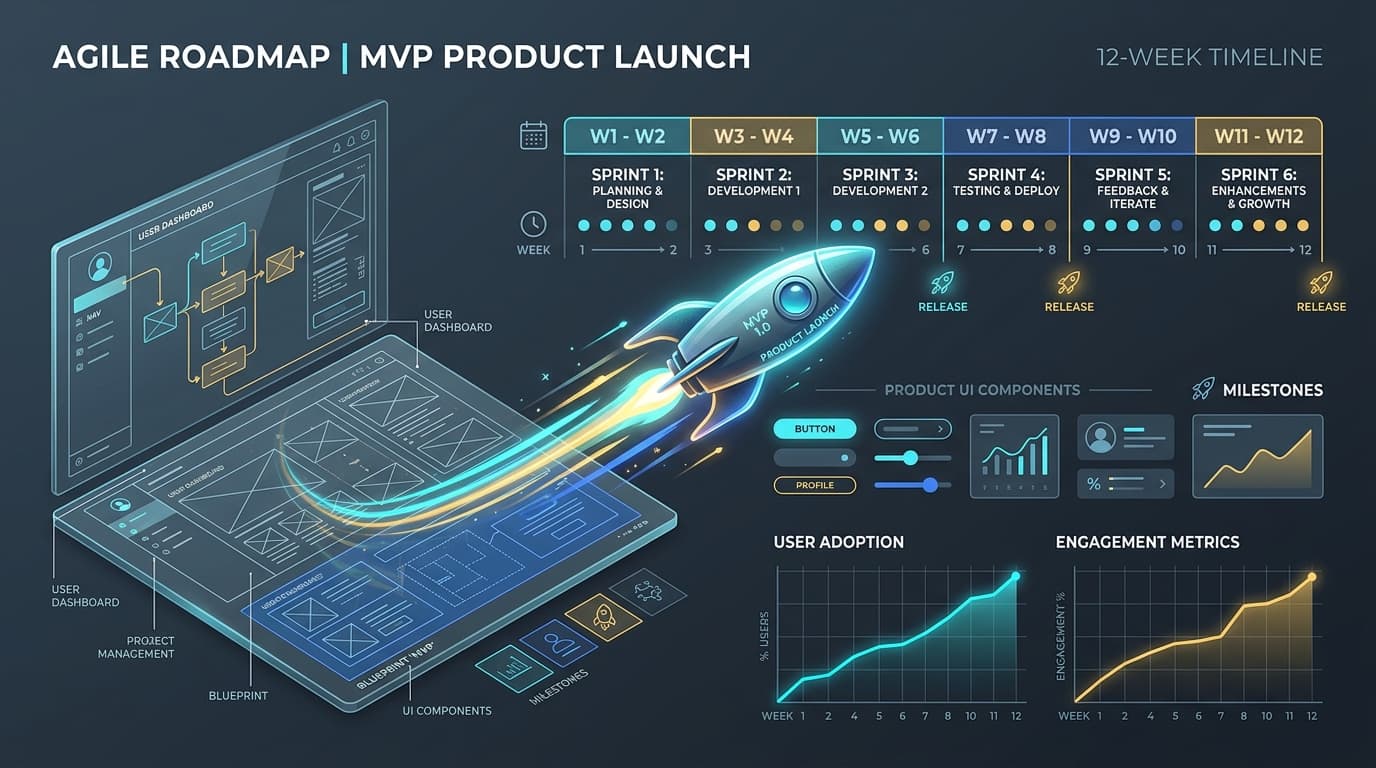
A minimum viable product (MVP) is the smallest version of your product that real customers will use, and ideally pay for. Its purpose is to learn quickly and cheaply whether your idea solves a real problem. Done well, an MVP takes 8–12 weeks and a fraction of the budget of a “complete” product. Done badly, it takes a year and still misses the point.
Start with one painful problem
Write one sentence: "[Customer] struggles with [problem], and today they [current workaround]." If you cannot write it clearly, you are not ready to build. The MVP should make that one workaround dramatically easier. Everything else waits.
Weeks 1–2: discovery
- Interview five to ten potential customers about the problem, not your solution.
- List every feature idea, then sort them into must have, nice to have and later. Be ruthless: most MVPs need three to five core features.
- Decide how you will measure success: for example, “20 businesses use it weekly” or “50 paid sign-ups”.
- Choose the platform. A responsive web app is fastest; a cross-platform mobile app (Flutter or React Native) makes sense when customers live on their phones.
Weeks 3–4: design
Create clickable prototypes before writing code. Test them with the same people you interviewed. Five short sessions will reveal most usability problems at a tiny cost compared with fixing them after development.
Weeks 5–10: build in short sprints
Work in one- or two-week sprints and demo working software every week. This is the single most effective way to keep a project on track: you see progress, change direction early and never get a surprise at the end. Typical MVP building blocks:
- Sign-up and login (email, Google or phone OTP)
- The core workflow that solves the problem
- Payments, if customers pay from day one
- A simple admin panel so you can support users without a developer
- Analytics to see what people actually do
Skip complex permission systems, custom reporting, multiple languages and integrations nobody has asked for yet.
Weeks 11–12: launch and learn
Release to a small group first. Watch analytics, talk to every early user and fix the biggest friction points. Then decide with data: double down, adjust or stop.
What an MVP costs
Built by an experienced team in India, a focused MVP typically costs $8,000–$25,000 (roughly ₹7–21 lakh), depending on the number of user roles, integrations and platforms. Budget an extra 15–20% per year for hosting, maintenance and improvements.
Common mistakes to avoid
- Building for everyone. Pick one customer type first.
- Perfect before public. If you are not slightly embarrassed by version one, you launched too late.
- No code ownership. Make sure the code lives in your own repository from day one.
- No plan after launch. Keep budget for the changes your first users will ask for.
An MVP is not a cheap version of your dream product; it is the fastest route to learning what the dream product should be. If you would like a second opinion on your feature list or budget, we are happy to review it with you for free.