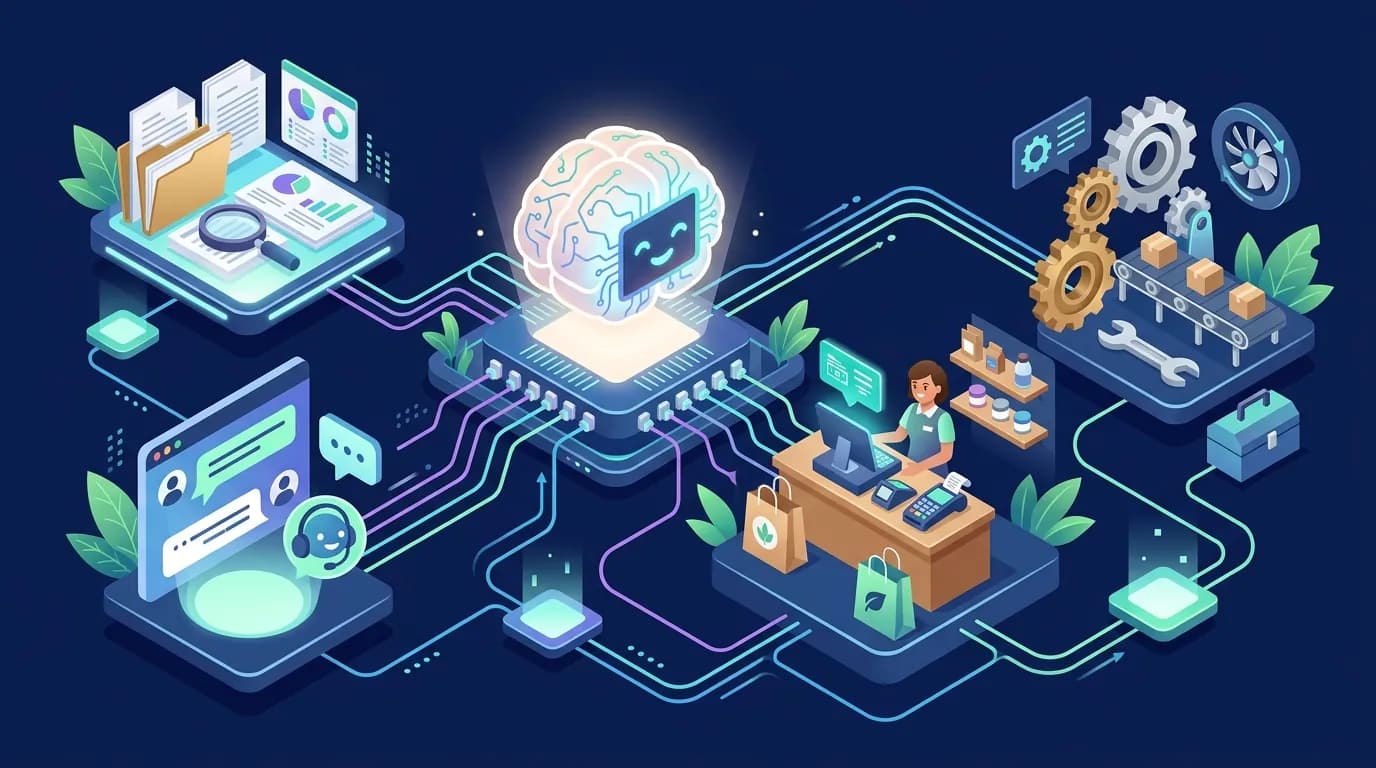
Retrieval-Augmented Generation (RAG) is the foundational architecture for connecting Large Language Models to proprietary business documents, technical manuals, and customer data. Yet more than 70% of enterprise RAG proof-of-concepts stall before production.
The symptoms are familiar: the AI answers trivial questions correctly, but hallucinates when answering complex policy queries, misses critical clauses in legal contracts, or retrieves outdated information.
In this guide, we review why naive vector search fails and how to engineer a resilient, enterprise-ready RAG pipeline.
1. Why Naive Vector Search Fails in Production
The standard beginner tutorial suggests: split a document every 500 characters, generate OpenAI embeddings, store them in a vector database, and perform cosine similarity search. Here is why this breaks down in real business use cases:
- Loss of Semantic Context Across Splits: If a table or crucial caveat is chopped in half between chunk 14 and chunk 15, neither chunk contains the full context required to answer accurately.
- The Keyword Blindspot: Vector embeddings capture semantic vibes, but struggle with precise identifiers (product SKU numbers, error codes, legal statute numbers, or exact person names). Cosine distance frequently ranks an irrelevant document with similar syntax higher than the exact SKU match.
- Vector Space Drift and Outdated Data: When documents update, orphaned embeddings linger in the index. The LLM then synthesizes contradictory answers by mixing legacy and current chunks.
2. The Modern Enterprise RAG Pipeline
A production-grade pipeline requires multiple stages between raw document ingestion and LLM response generation:
[Raw Document: PDF/Doc/DB]
         │
         ▼
[Document Parsing & Layout Analysis (tables, hierarchy)]
         │
         ▼
[Contextual Chunking with Document Metadata Enriched]
         │
    ┌────┴────────────────────────┐
    ▼                             ▼
[Dense Vectors: pgvector/Qdrant] [Sparse Index: BM25/Fulltext]
    │                             │
    └────┬────────────────────────┘
         ▼
[Reciprocal Rank Fusion (RRF)]
         │
         ▼
[Cross-Encoder Reranking (Cohere Rerank / BGE-Reranker)]
         │
         ▼ Top 5 Highest-Precision Chunks
[Grounding Prompt + LLM Synthesis + Strict Citations]
3. Hybrid Search: Combining Dense and Sparse Retrieval
The most impactful upgrade to any RAG system is combining dense vector embeddings with sparse keyword search (BM25 or PostgreSQL tsvector).
Dense retrieval understands that “automobile” relates to “car” or “vehicle”. Sparse retrieval guarantees that if a user searches for "WAS-4092-B", the system returns the exact document containing that identifier.
We combine the scores using Reciprocal Rank Fusion (RRF):
RRF_Score(d) = SUM ( 1 / ( k + rank_dense(d) ) ) + ( 1 / ( k + rank_sparse(d) ) )
Setting k = 60 provides a balanced distribution that prevents either retrieval method from overwhelming the result set.
4. Contextual Chunking and Table Extraction
Instead of splitting raw text by fixed token counts:
- Parse document structure first: Extract headings, paragraphs, and markdown tables.
- Prepend contextual headers: Every chunk should carry its parent section title and document breadcrumb. For example, prepend:
[Document: Employee Handbook 2026 > Section: Health Benefits > Dental Coverage]. This ensures the embedding captures both the granular text and its high-level domain. - Preserve Tables As Markdown or JSON: LLMs comprehend markdown tables effortlessly. Converting PDF grid lines into structured markdown tables preserves column-row relationships that naive text extractors destroy.
5. Two-Stage Reranking
Retrieving the top 30 candidates using hybrid search is fast (under 40ms). However, feeding 30 chunks directly into an LLM context window causes the “lost in the middle” phenomenon and inflates token costs.
Use a dedicated cross-encoder reranking model (such as Cohere Rerank 3 or BGE-Reranker-Large) to re-score the top 30 candidates against the exact user query. Filter down to the top 3 to 5 highest-scoring passages before building the final prompt. This single step eliminates up to 80% of hallucinated responses.
6. Privacy, Enterprise Security, and Zero-Data Retention
When deploying RAG for internal business operations:
- Enforce Document Access Permissions at Retrieval Time: If user A does not have permission to view payroll spreadsheets in the ERP, your vector query must apply metadata filters
user_groups && ['hr_executives']before returning chunks. - Zero-Retention API Agreements: Ensure all third-party model inference providers operate under signed agreements where prompts and completion data are never logged or used for model training.
- On-Premise or Private VPC Deployments: For regulated healthcare and financial institutions, WasTechno deploys open-weights models (such as Llama 3 or Mistral) inside private AWS/GCP VPCs so no data ever traverses the public internet.
Explore our custom AI development services to build a secure, enterprise-grade AI assistant tailored to your company documents.